
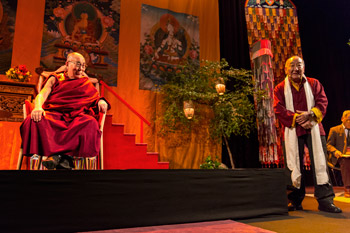
Strength Through Compassion and Connection 2
Copenhagen, Denmark, 11 February 2015 – The first engagement of His Holiness the Dalai Lama’s day in Copenhagen was a meeting with the Press. Journalists respectfully welcomed him to the room and he began by outlining his three commitments.
 |
| His Holiness the Dalai Lama meeting with members of the press in Copenhagen, Denmark on February 11, 2015. Photo/Olivier Adam |
 |
| His Holiness the Dalai Lama meeting with members of the press in Copenhagen, Denmark on February 11, 2015. Photo/Jeremy Russell/OHHDL |
At the moment, China remains a closed and controlled society, but 1.3 billion people have a right to know reality. They have the capacity to judge right from wrong. As it is, censorship, the effort to deceive the people, is wrong. The important thing, His Holiness said, about relations with China is to overcome suspicion and establish friendship. Asked whether he felt there had been any missed opportunities for Tibet in its relations with China, His Holiness surveyed what had happened from his escape to Yatung in 1950 after PLA troops crossed the Tibetan border, the signing of the 17 Point Agreement in May 1951, to his own visit to Peking 1954-55. During that time he met all the Chinese leaders, including about 30 meetings with Chairman Mao, with whom he had cordial relations. However, in 1959 he faced no alternative but to escape.
In 1974 Tibetans in exile decided not to raise the issue of Tibet at the UN any more, but to prepare to talk to China, which meant not seeking independence. In 1978, Deng Xiaoping indicated a willingness to talk and in 1979 an envoy was sent to do so. During the 1980s, at the time of Hu Yaobang, hopes of a negotiated were raised. But as the pro-democracy movement emerged among students, Hu Yaobang was dismissed and replaced by hardliner, Li Peng. The Tiananmen massacre followed.
Meetings resumed in 1992 under Jiang Zemin, but hardliners continued to pursue suppressive policies and found it convenient to blame His Holiness for whatever trouble arose in Tibet. Since then, there have been many indications that Chinese intellectuals who become aware of the proposed Middle Way Approach to a mutually agreeable solution are supportive of it and critical of their government’s policies.
His Holiness answered a question about violence in the name of religion with the suggestion that it is often a case ignorant religious extremists manipulating others. He recalled sending condolences to President Bush after the September 11th tragedy and expressing the hope that the consequences would be dealt with in a non-violent way.
 |
| His Holiness the Dalai Lama meeting with Danish religious leaders in Copenhagen, Denmark on February 11, 2015. Photo/Olivier Adam |
His Holiness had a cordial inter-religious meeting with Danish representatives of Christianity, Judaism, Islam and Hinduism. He told them that on a human level we are all the same. Moreover, he said, all our major religious traditions focus on the practice of love and compassion, supported by forgiveness, tolerance and simplicity. He expressed his great admiration for the Hindu practitioners and Christian monks and nuns he has met who live really simple lives governed by self-discipline. The group explained their plans for an inter-religious conference in 2017/18 and sought His Holiness’s support.
In an interview with Mette Holm for the TV2 television channel, she asked about his expected meeting with Danish politicians. His Holiness told her he would like to see a delegation of experts go to Tibet to investigate the ecological situation. He hoped they could assess what damage has already been done and what steps can be taken to avert further damage. She asked how Chinese Buddhists react when they come to meet him and he told her they are often in tears. As to whether there is freedom to practise Buddhism in Tibet he pointed out that when he took his final exams in 1959 there between 7000 and 8000 monks studying in Drepung Monastery. Today, there are reports of fewer than 100 with no proper teachers and no serious study.
In a second interview after lunch with Mette Hybel for DR1 television, she asked if he felt his influence was diminishing when politicians declined to meet him. He replied that he is primarily interested in interacting with members of the public. She also asked how things are in Tibet and he told her that in some places they are better and in other places worse, depending on the whims of the local Chinese officials. But he said he remained optimistic that things will change for the better.