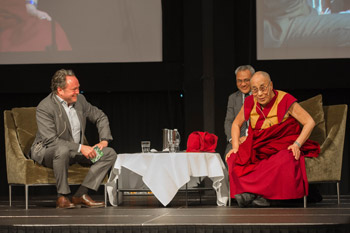
Guest at the International Student Festival in Trondheim
February 10th 2015
Trondheim, Norway, 9 February 2015 – From Basel at the heart of Europe, where the territories of France, Switzerland and Germany converge, His Holiness the Dalai Lama this morning flew due north to a city closer to the edge of the continent. Trondheim, Norway’s first capital more than a thousand years ago, is the site of another convergence. Standing on the south shore of the Trondheimsfjord at the mouth of the river Nidelva, since 1990 Trondheim has been the location of the world’s largest International Student Festival. ISFiT serves as a meeting place for discussion and debate, an arena where ideas are born, friendships are made and valuable lessons are learned. It takes place every other year.
|
| His Holiness the Dalai Lama meeting with Aayat Algormozi, the winner of the ISFiT Student Peace Prize, in Trondheim, Norway on February 9, 2015. Photo/foto.samfundet.no |
Representatives from the Indian Embassy and students from ISFiT met His Holiness when he landed at Trondheim airport and escorted him to his hotel next door to the Clarion Conference Centre. From the dining room where he enjoyed lunch with a group of students there was a wide view out over a forbidding sea. Before joining the discussions he was introduced to the winner of this year’s Students’ Peace Prize, Aayat Alqormozi, who was awarded it for her unwavering struggle for democracy and human rights in Bahrain.
When he entered the conference hall he was greeted by a rousing cheer from the 1800 students, 500 from abroad, waiting to hear him. Marius Jones, President of ISFiT, in his introductory remarks called the festival a gathering of students from across the globe who can change the future and create a better world. The theme this year is corruption.
His Holiness first participated in ISFiT in 1994. Invited by the moderator, Fredrik Græsvik, to make a few remarks to start the session, he began:“Good afternoon brothers and sisters. It’s a great honour for me to meet with you to discuss our various experiences. As young people you have a long future ahead of you, and as a person nearly 80 years old, I suppose I’m the one with experience. Time goes on. It doesn’t stand still. The past is gone so we can’t change it, although we can learn from it. We are still at the start of the 21st century so it may be possible, before it ends, to create a better, happier world.”He spoke about the 20th century’s having been a period of spectacular development, but also an era of violence and bloodshed. If the world had become a better place as a result, that bloodshed might have been justified, but that was not the case. He referred to corruption as being a form of violence too and pointed out that even religion provides an opportunity for some corrupt people to exploit others. He clarified that the distinction between violence and non-violence lies less in the nature of a particular action and more in the motivation with which it is done. Actions motivated by anger and greed tend to be violent, whereas those motivated by compassion and concern for others tend to be non-violent. He said we won’t bring about peace merely by praying for it, we have to take steps to tackle the violence and corruption that disrupt peace.
|
| His Holiness the Dalai Lama speaking at the International Student Festival in Trondheim (ISFiT) in Trondheim, Norway on February 9, 2015. Photo/foto.samfundet.no |
“Those of us who are more than 30 years old, who belong to the 20th century, have created a lot of problems. Unfortunately they remain for you young people to resolve. You have the responsibility and the opportunity to create a better world. You’ll need to approach things in a broader way, not limiting your aims to the interest of only your community or your nation, but taking account of the needs of all human beings. This will require will-power, vision and determination. And for that you’ll need a strong sense that humanity is one family.
“I’m here with you now as just another human being. We are the same physically, mentally and emotionally, but we tend to focus instead on the secondary differences between us. If all 7 billion human beings had a sense of the oneness of humanity, we’d have no basis for quarrelling. What we need to do instead is to focus on making friends with each other. You young people have a great opportunity; you have the potential to do this.”